Aging infrastructure at risk
Defense, aerospace, energy and infrastructure assets are aging faster than inspection capacity. Late detection means unscheduled maintenance, downtime, higher repair cost and safety risk.
We turn nondestructive evaluation and engineering data into decisions you can defend, using physics-based AI for automated defect detection, characterization and structural integrity assessment.
Measured pulse-echo signals from our CFRP panels, shown with UT Studio's cross-validated AI verdicts. Demonstration only, not for inspection decisions.
Organizations collect more inspection data than ever, but most of it is never fully analyzed. Four gaps keep asset owners reactive.
Defense, aerospace, energy and infrastructure assets are aging faster than inspection capacity. Late detection means unscheduled maintenance, downtime, higher repair cost and safety risk.
Most organizations still fix failures after the fact. Predictive maintenance through intelligent analytics can substantially reduce lifecycle costs.
Traditional NDE is slow, labor-intensive and operator-dependent. Results can be subjective and hard to trace, which is not enough for high-consequence, high-volume work.
One integrated pipeline from sensor to decision. Select a stage to see what we deliver.
Three programs from our lab, each with a live demo that runs in your browser using real data or exact reference solutions.
Ultrasonic testing is the workhorse of nondestructive evaluation. It is used on aerospace structures, welds, pipelines, pressure vessels and civil infrastructure. Interpreting the signals still depends on skilled operators working one A-scan at a time, and results get harder to trust on curved or complex geometry.
DNE built UT Studio, a platform for ultrasonic analysis and automated defect recognition (ADR). It builds A-, B-, C- and D-scans, runs a 21-step signal-processing chain and adapts its gates to curved geometry. It also trains explainable AI models on your own labelled data, so the same workflow carries over to new materials, parts and defect types.
Results from DNE's composite inspection study (600 measured A-scans, 3 test panels, 5-fold cross-validation). Performance on other materials, geometries and equipment will differ and must be validated for each application.
DNE LLC's UT Studio AI tool labels every A-scan as no defect, defect, and other features, and its adaptive gating is tested on a curved composite skin. The accuracy figures above come from this study.
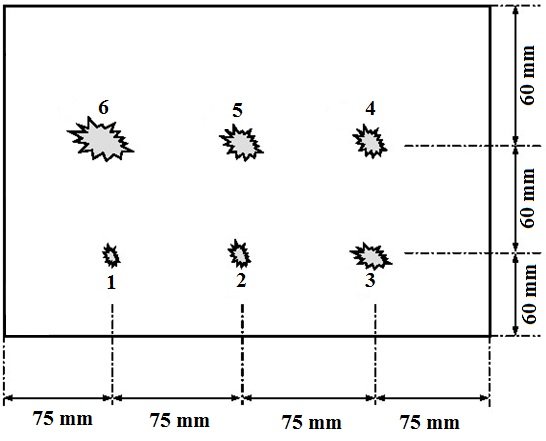
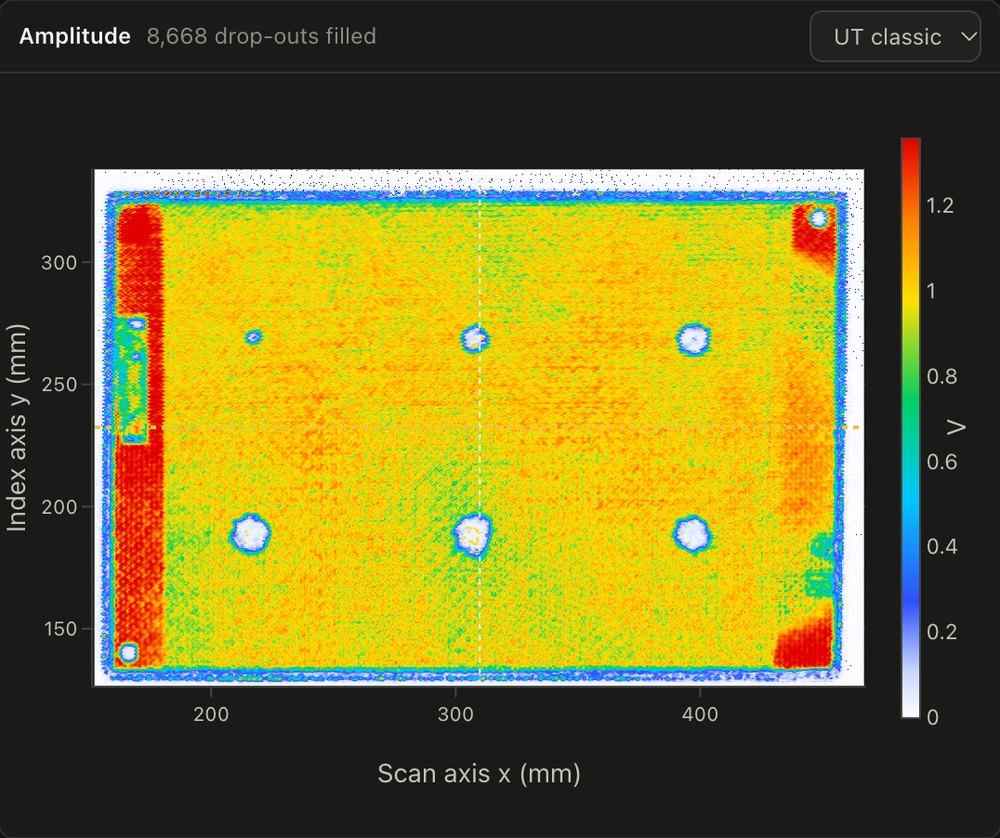
Three test standards with embedded defects. Pick one to compare the design drawing with UT Studio's scan of it.
Panel R is a simulated curved skin (2 m radius) with a 1.2 mm joggle. With fixed gates, signal loss from curvature looks like damage. UT Studio tracks the front wall of every A-scan and compensates for tilt, so only the real defects remain. Drag the divider to compare.
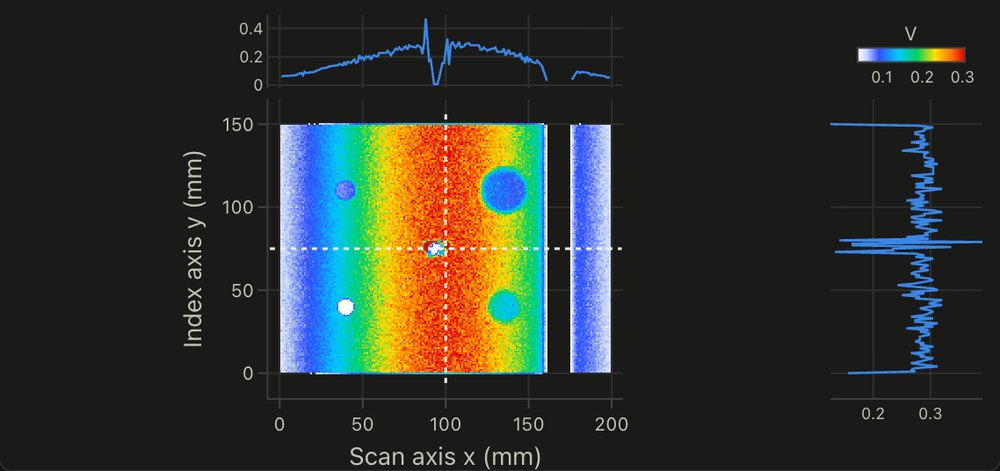
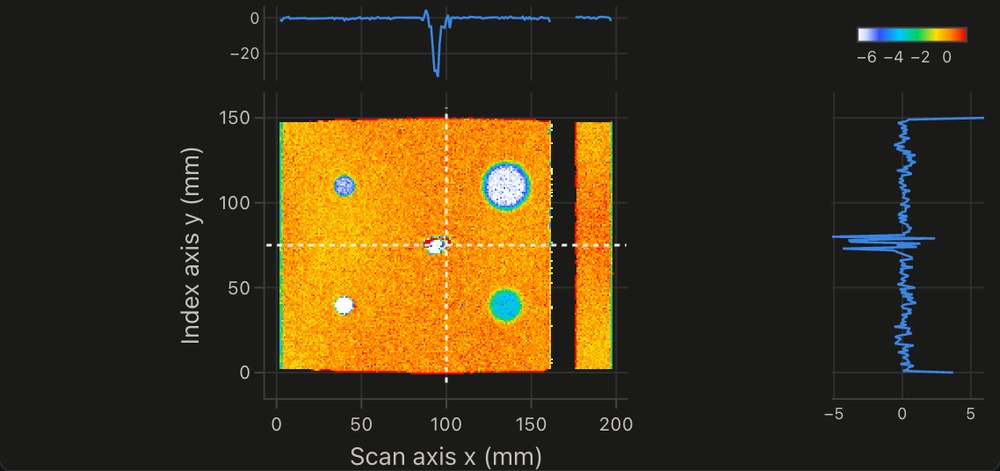
The blank strip at 162–175 mm is the joggle: the surface is too steep for the echo to return, so UT Studio flags it as geometry-limited.
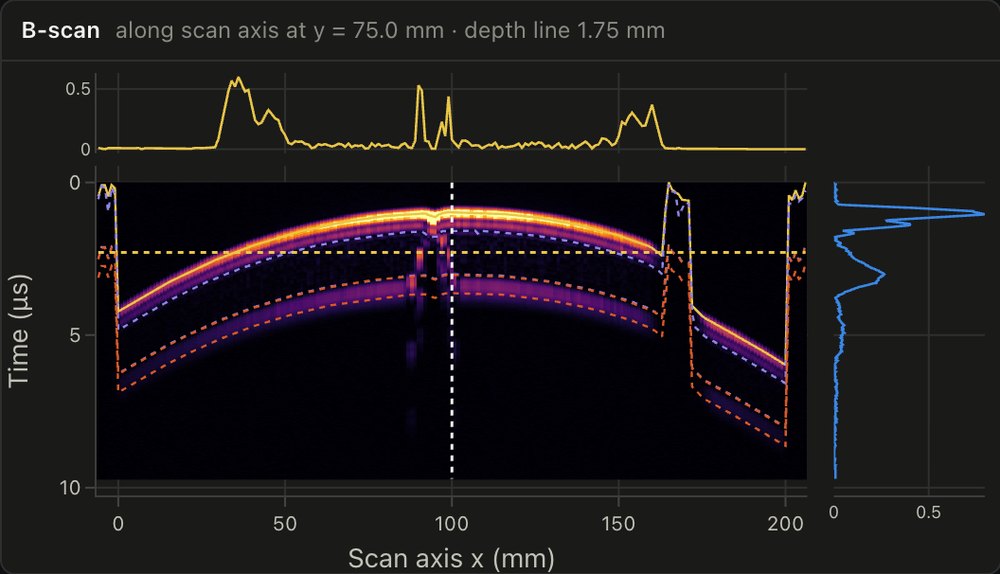
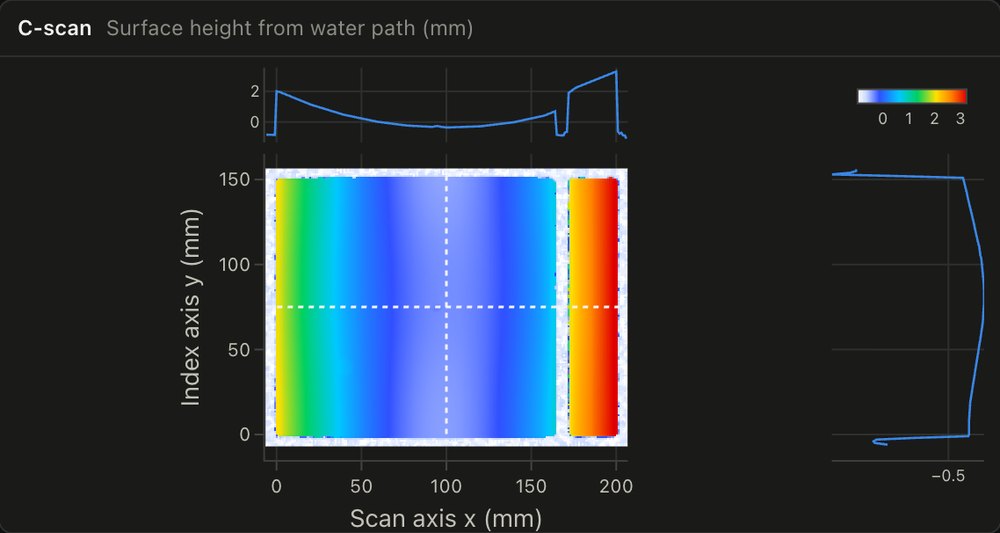
Areas too steep to inspect (7.3%) are flagged as geometry-limited instead of being called defects. For the AI, training with curved-part augmentation keeps accuracy at 99.5% on geometry-distorted signals. The same model trained only on flat panels drops to 66%.
Pick a defect type and draw a measured signal. You'll see it against each class's average waveform and the AI's confidence for each class. Each verdict comes from cross-validation, so the model that judged the signal never saw it in training.
Demonstration only. Results are from specific test specimens or simulations and must not be used for inspection acceptance, certification or safety-critical decisions.
Select a classifier to see its confusion matrix: rows are the true defect type, columns what the model predicted. Switch to the curved-part stress test to see which models survive geometry distortion.
Overall accuracy (%). The bars start at 50% so small differences are visible.
Demonstration only. Results are from specific test specimens or simulations and must not be used for inspection acceptance, certification or safety-critical decisions.
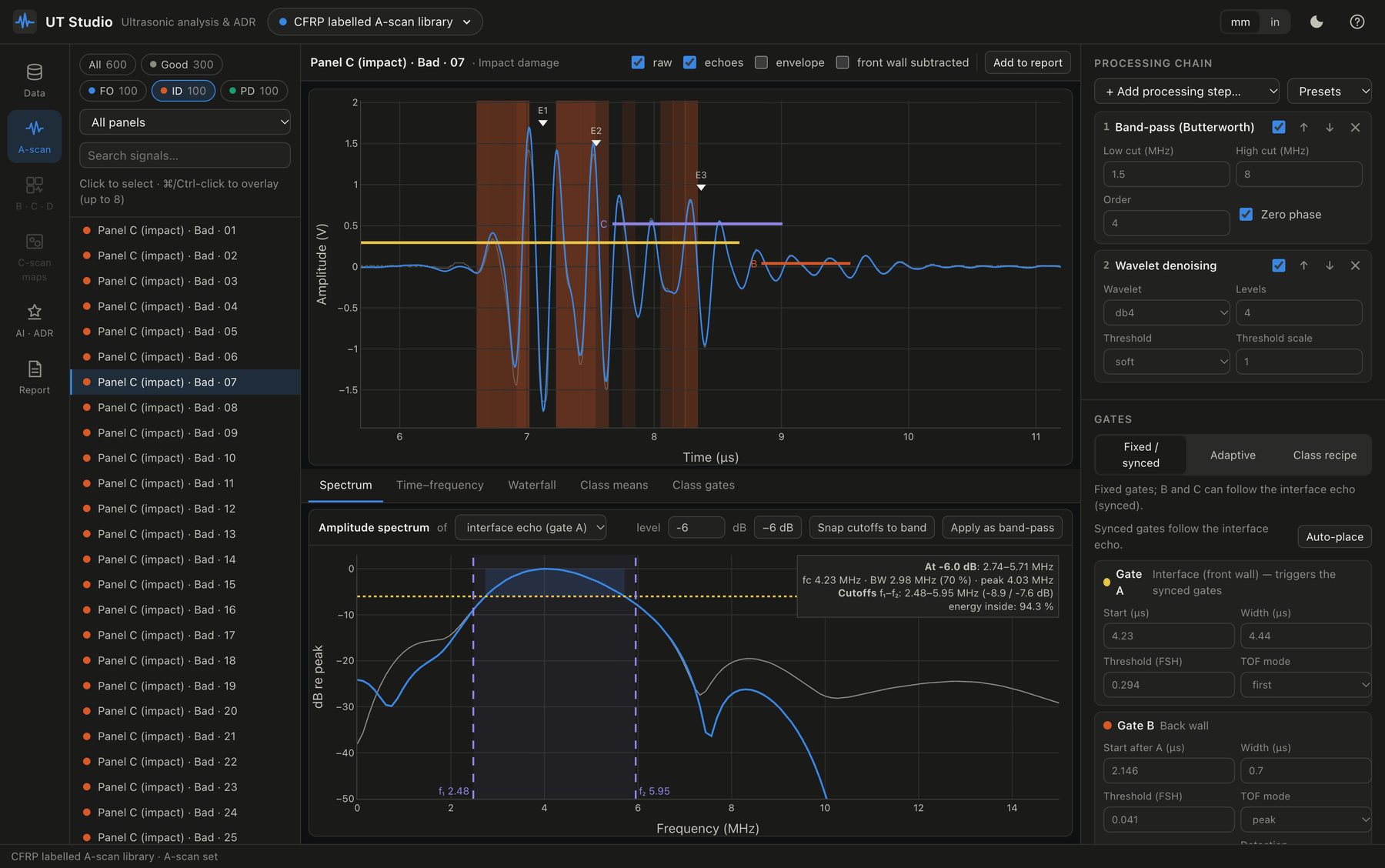
Real screens from UT Studio. Pick a capability, and click the screenshot to see it full size.
Digital image correlation (DIC) measures displacement and strain over a whole surface by tracking a speckle pattern between photographs. Strain gauges give one number at one point. DIC shows where strain concentrates around holes, cracks and joints.
DNE built DIC Studio, a desktop DIC application with a native multi-threaded correlation engine. It follows a guided, step-by-step workflow and adds metrology tools that let engineers quantify measurement error on their own speckle pattern.
A plate with a hole is pulled left-to-right. Move the load slider and hover over the specimen to probe strain. The overlay is the exact Kirsch solution that DIC Studio's synthetic test images are generated from, so the software can be checked against a known answer.
Demonstration only. Results are from specific test specimens or simulations and must not be used for inspection acceptance, certification or safety-critical decisions.
Probability of Detection (POD) is the standard way to prove an inspection is good enough. Engineers inspect specimens with known flaws, record hits and misses, and fit a curve. The key number is a90/95: the flaw size found 90% of the time, with 95% confidence.
DNE's POD Analyzer implements hit/miss POD analysis with both parametric (log-logistic) and nonparametric binomial methods. It also supports four-arm studies that compare human inspectors, AI, and the two working together, which matters when you are qualifying AI-assisted inspection.
Set how good the "true" inspection is and how many flawed specimens you test. Each run simulates a new study, fits a log-logistic POD curve by maximum likelihood, and computes the 95% lower confidence bound. See how sample size changes the a90/95 you can claim.
Simulated data for illustration. Qualification studies need a designed specimen set and the full POD Analyzer workflow.
Demonstration only. Results are from specific test specimens or simulations and must not be used for inspection acceptance, certification or safety-critical decisions.
A five-phase path from your problem statement to a sustained, field-ready solution.
Technical assessment of your inspection challenges, data environment and system requirements.
Physics-based solution architecture: sensor selection, ML pipeline design and modeling approach.
Laboratory development and validation of NDE methods, AI models and signal processing algorithms.
Field integration, in-situ testing, operator training and performance verification on real assets.
Ongoing analytics support, model retraining, lifecycle monitoring and continuous improvement.
Our models use physics-based signal features, and every call comes with the evidence behind it, so results can be checked against how real materials and structures behave.
From laboratory R&D through field deployment, we cover the full pipeline: sensing, signal processing, AI analysis, modeling and decision support, delivered as one integrated solution.
Our methods are designed for harsh environments, noisy data and applications where reliability matters most: the standard that defense, aerospace and energy demand.
We combine NDE hardware expertise with AI software, experimental mechanics and simulation. Few teams integrate all four, and doing so closes the gap between data and insight.
Advanced engineering intelligence for systems operating in high-consequence environments, where precision and reliability are non-negotiable.
DeepNeuro Engineering LLC (DNE) specializes in nondestructive evaluation, experimental mechanics and intelligent data-driven analysis. We integrate physics-based modeling, advanced signal processing and artificial intelligence to assess structural integrity, detect and characterize defects, and predict performance and life.
Our team combines hands-on field testing experience with rigorous research and development, enabling rapid transition from concept to deployment. From laboratory experiments to in-field validation, we support the full lifecycle of engineered systems: design, verification, operation and sustainment.
Transform NDE and engineering data into actionable insight, delivering reliable, AI-driven solutions for automated defect detection, characterization and structural integrity assessment.
A future where intelligent, autonomous inspection systems redefine how components and structures are designed, evaluated and sustained, making critical infrastructure safer, more efficient, more reliable and more resilient.
We work with defense contractors, aerospace OEMs, energy operators and infrastructure owners to deploy next-generation NDE and AI solutions.